


If you are running a business in 2026, I am willing to bet you have asked yourself this at least once: "Is SEO actually worth paying for anymore?"
With Google’s constant algorithm updates, AI Overviews, rising competition, and thousands of “SEO gurus,” the confusion is natural. Every business owner wants more visibility, but nobody wants to waste money on something that does not work.
In this article, I am breaking down what SEO really involves, how you can measure whether it's actually making you money, who benefits most from it, and—most importantly—how to figure out if hiring an SEO agency is worth your money or just a waste of your budget.
Understanding What SEO Services Actually Include
There is a lot of confusion about what SEO actually is. Some people think it's just stuffing keywords into your content. Others think if you get enough backlinks, you're golden. But here's the reality: modern SEO is not one trick—it's a whole system working together.
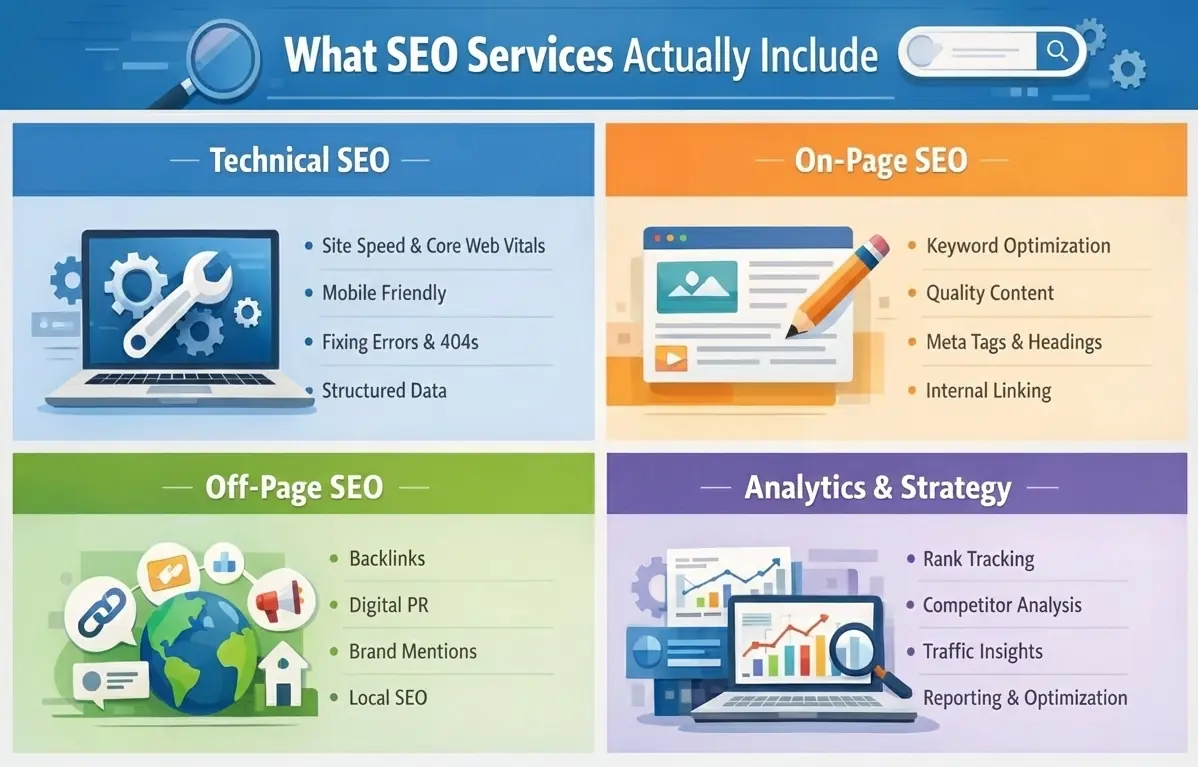
Technical SEO
This ensures that Google can crawl, index, understand, and rank your website properly. It includes:
- Improving Core Web Vitals (speed, stability, loading)
- Fixing indexing errors
- Optimizing site architecture
- Mobile responsiveness
- Redirects, 404 fixes, broken links
- Structured data (Schema)
Technical SEO is the foundation. Without it, even the best content will struggle to rank.
On-Page SEO
This is what makes your website relevant for search queries. It includes:
- Keyword optimization
- Writing high-quality content
- Optimizing titles, meta descriptions, headings
- Improving internal linking
- Increasing topical authority
- Enhancing user experience
Google now rewards content that demonstrates Experience, Expertise, Authoritativeness, and Trust (E-E-A-T).
Off-Page SEO (Authority Building)
Backlinks still matter in 2026, but the quality matters more than quantity. Off-page SEO includes:
- Digital PR
- Contextual backlinks
- Building brand mentions
- Improving domain reputation
Local SEO
For brick-and-mortar businesses:
- Google Business Profile optimization
- Local citations
- Local keyword targeting
- Reviews management
Analytics & Strategy
A genuine SEO service includes consistent:
- Tracking of rankings, clicks, impressions
- Competitor analysis
- Keyword gap analysis
- Traffic behavior insights
- Adjusting strategies based on performance
Real SEO is an ongoing, adaptive process. Not a one-time fix.
Why SEO Still Matters in 2026
Despite AI, voice search, and algorithm changes, SEO remains one of the most powerful growth channels. Here’s why::
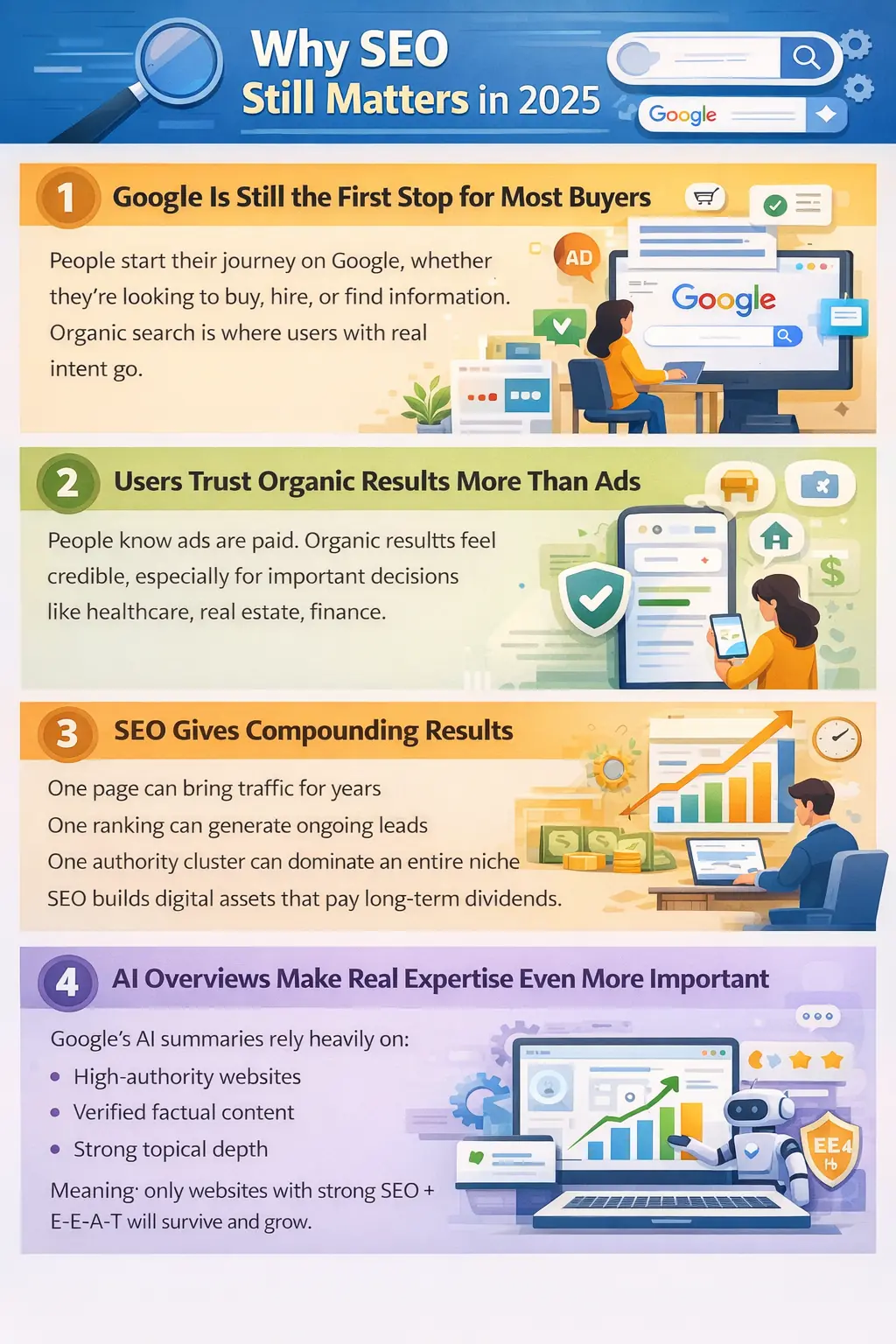
1. Google Is Still the First Stop for Most Buyers
Whether people are looking to buy something, hire someone, or just find information, They are still starting that journey on Google. And organic search? That's where the people with real intent are—the ones actually ready to take action.
2. Users Trust Organic Results More Than Ads
People know ads are paid. Organic results feel more credible, especially for high-investment decisions like healthcare, real estate, finance, and professional services.
3. SEO Gives Compounding Results
Ads stop giving results as soon as you stop spending.
But with SEO:
- One page can bring traffic for years
- One ranking can generate ongoing leads
- One authority cluster can dominate an entire niche
SEO builds digital assets that pay long-term dividends.
4. AI Overviews Make Real Expertise Even More Important
Google’s AI-generated summaries rely heavily on:
- High-authority websites
- Verified factual content
- Strong topical depth
Meaning: only websites with strong SEO + E-E-A-T will survive and grow.
Are SEO Services Worth the Cost? Understanding the ROI
Let’s break down the economics.
SEO is not cheap—good services usually cost more than low-quality freelancers or automated software. But the return can far outweigh the cost.
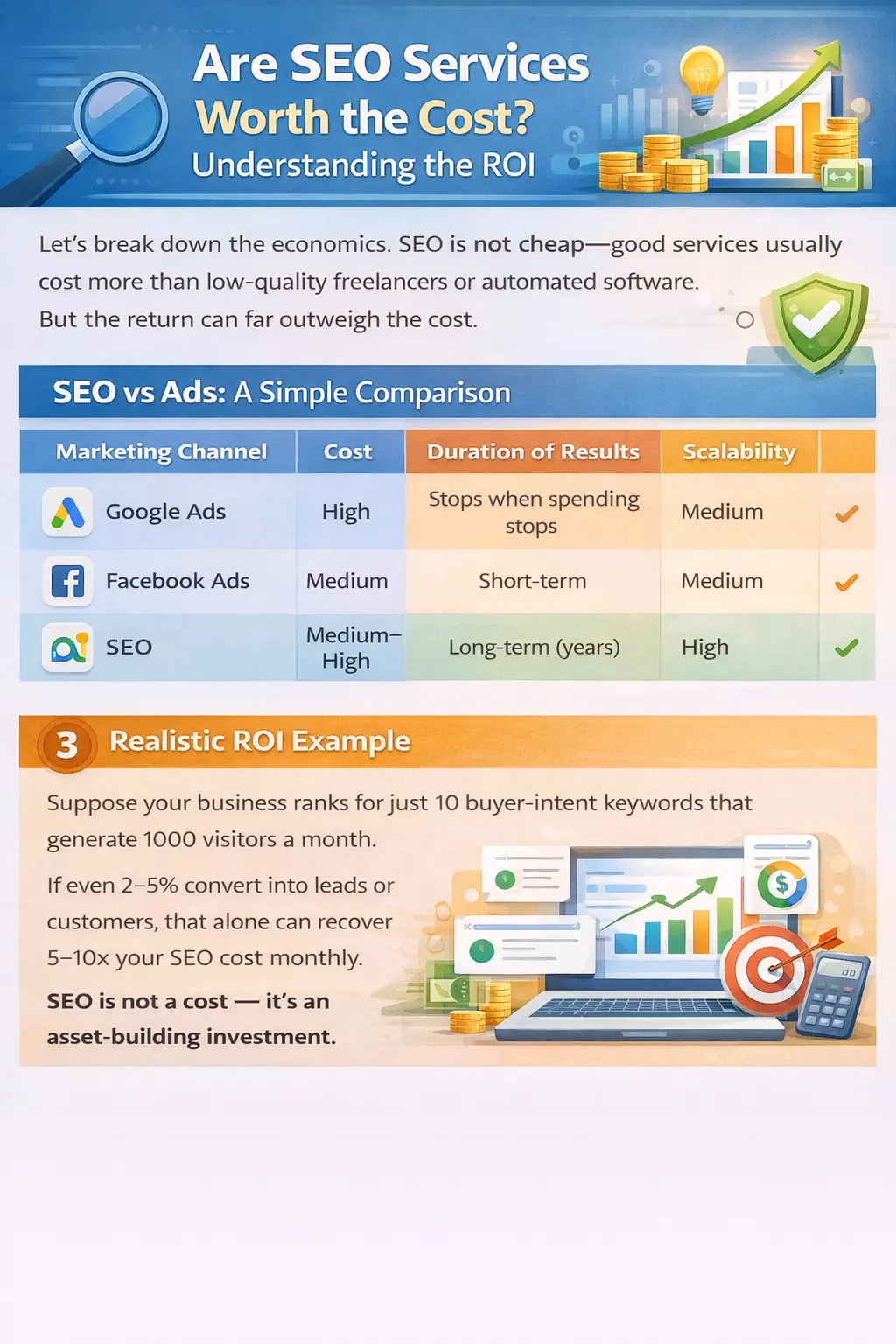
SEO vs Ads: A Simple Comparison
| Marketing Channel | Cost | Duration of Results | Scalability | Trust Level |
|---|---|---|---|---|
| Google Ads | High | Stops when spending stops | Medium | Low |
| Facebook Ads | Medium | Short-term | Medium | Low |
| SEO | Medium–High | Long-term (years) | High | High |
Realistic ROI Example
Suppose your business ranks for just 10 buyer-intent keywords that generate 1000 visitors a month.
If even 2–5% convert into leads or customers, that alone can recover 5–10x your SEO cost monthly.
SEO is not a cost — it's an asset-building investment.
Who Should Invest in SEO (and Who Shouldn’t)
SEO is extremely powerful, but not for everyone.
SEO Is Worth It For:
1. Local Businesses
Dentists, gyms, salons, clinics, restaurants — people search for these services daily.
2. Ecommerce Brands
Even ranking one product category can increase monthly revenue significantly.
3. Service-Based Companies
Agencies, freelancers, repair services, consultants — organic leads are more qualified.
4. Bloggers & Publishers
Advertising + affiliate revenue depends entirely on organic traffic.
5. Startups With Long-Term Vision
SEO is a growth engine, not a quick fix. But it compounds beautifully over time.
SEO Is Not Worth It For:
1. Businesses Expecting Quick Leads
SEO is slow. If you need sales tomorrow, run ads, not SEO.
2. Niches With Very Low Search Demand
If nobody is searching for your product, SEO cannot magically create demand.
3. Companies With Very Tight Budgets
SEO requires ongoing effort. Stopping early can waste the entire investment..
Why Some People Think SEO Doesn’t Work
Many business owners get disappointed with SEO not because SEO doesn’t work — but because they had the wrong expectations or worked with poor-quality agencies.
Common Myths:
“SEO should give results in 1 month.”
Reality:
- Technical fixes: 2–6 weeks
- Keyword movement: 3–6 months
- Real ROI: 6–12 months
“Backlinks alone can rank any page.”
NO. Backlinks without content, structure, and relevance don’t work anymore.
“ChatGPT can replace SEO agencies.”
AI can help with content creation, but SEO requires:
- Strategy
- Market understanding
- Technical fixes
- Experience with complex issues
- Ongoing optimization
“SEO is dead because of AI.”
Actually, AI increases the demand for authoritative, structured, fact-based content — which is exactly what SEO builds.
How to Know If an SEO Agency Is Actually Good
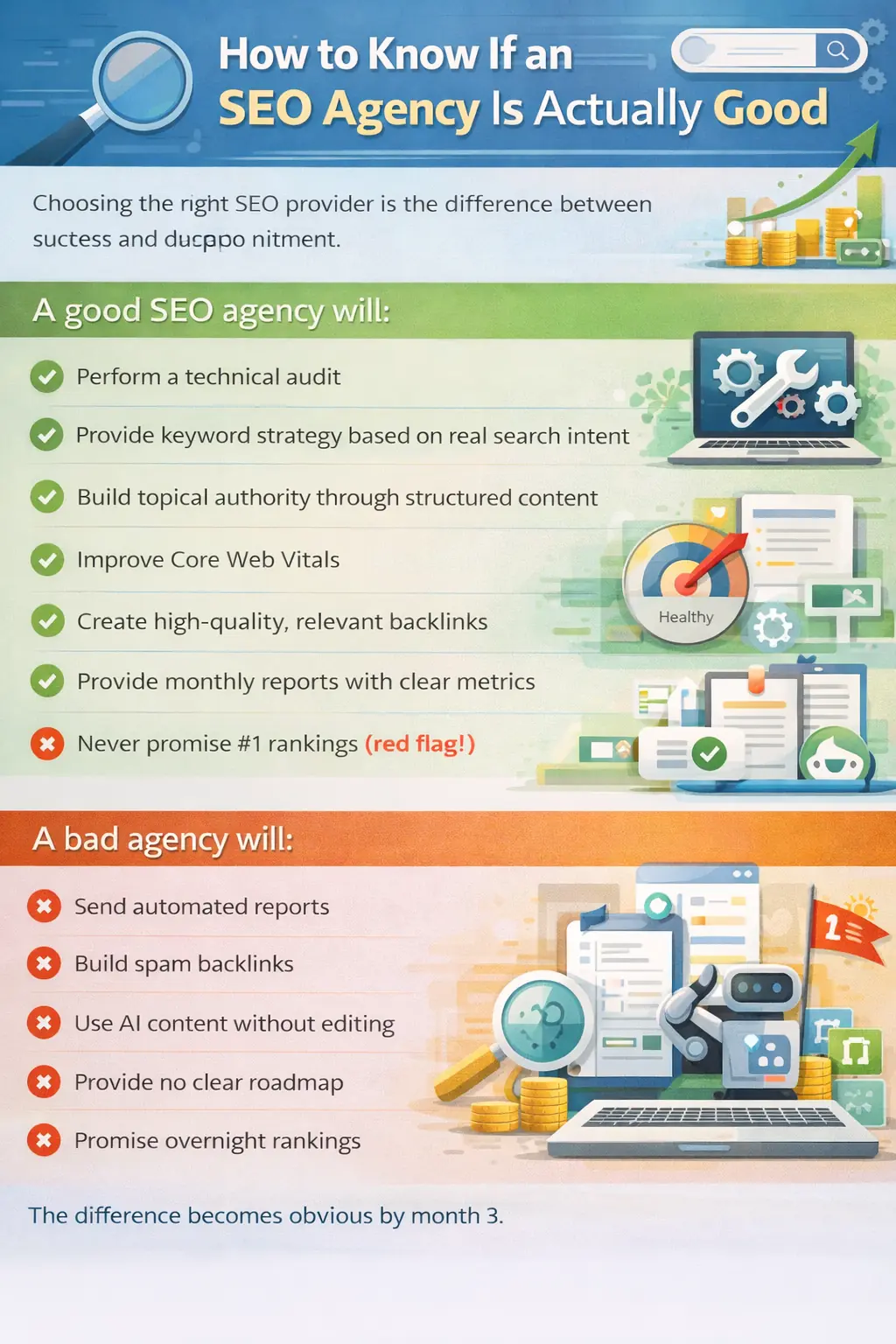
Choosing the right SEO provider is the difference between success and disappointment.
A good SEO agency will:
- Perform a technical audit
- Provide keyword strategy based on real search intent
- Build topical authority through structured content
- Improve Core Web Vitals
- Create high-quality, relevant backlinks
- Provide monthly reports with clear metrics
- Never promise #1 rankings (red flag!)
- Tailor strategies based on your business goals
A bad agency will:
- Send automated reports
- Build spam backlinks
- Use AI content without editing
- Provide no clear roadmap
- Promise overnight rankings
The difference becomes obvious by month 3.
The Honest Timeline: How Long SEO Really Takes
SEO is slow at first — but becomes explosive later.
Month 1–2
- Technical fixes
- Competitor & keyword research
- Content planning
- Initial optimizations
Month 3–4
- Content starts indexing
- Early ranking movement
- More impressions
Month 5–6
- Stable ranking growth
- Increased organic traffic
- Better conversions
Month 6-12
- Strong keyword positions
- Authority compounding
- Significant ROI
The most profitable websites today have been investing in SEO consistently for years.
Final Verdict: Are SEO Services Really Worth It?
The short answer: Yes — SEO services are absolutely worth it in 2026.
But only under the right conditions.
SEO Is Worth It When:
- You have a long-term vision
- You want sustainable growth
- You want to reduce ad dependency
- You want authority in your niche
- You choose a transparent, skilled agency
SEO Is Not Worth It When:
- You expect instant results
- You don't have the budget for several months
- You buy cheap, low-quality packages
When done correctly, SEO becomes one of the highest-ROI marketing channels available. It builds trust, visibility, credibility, and consistent traffic — all without paying for ads every day.