In this article
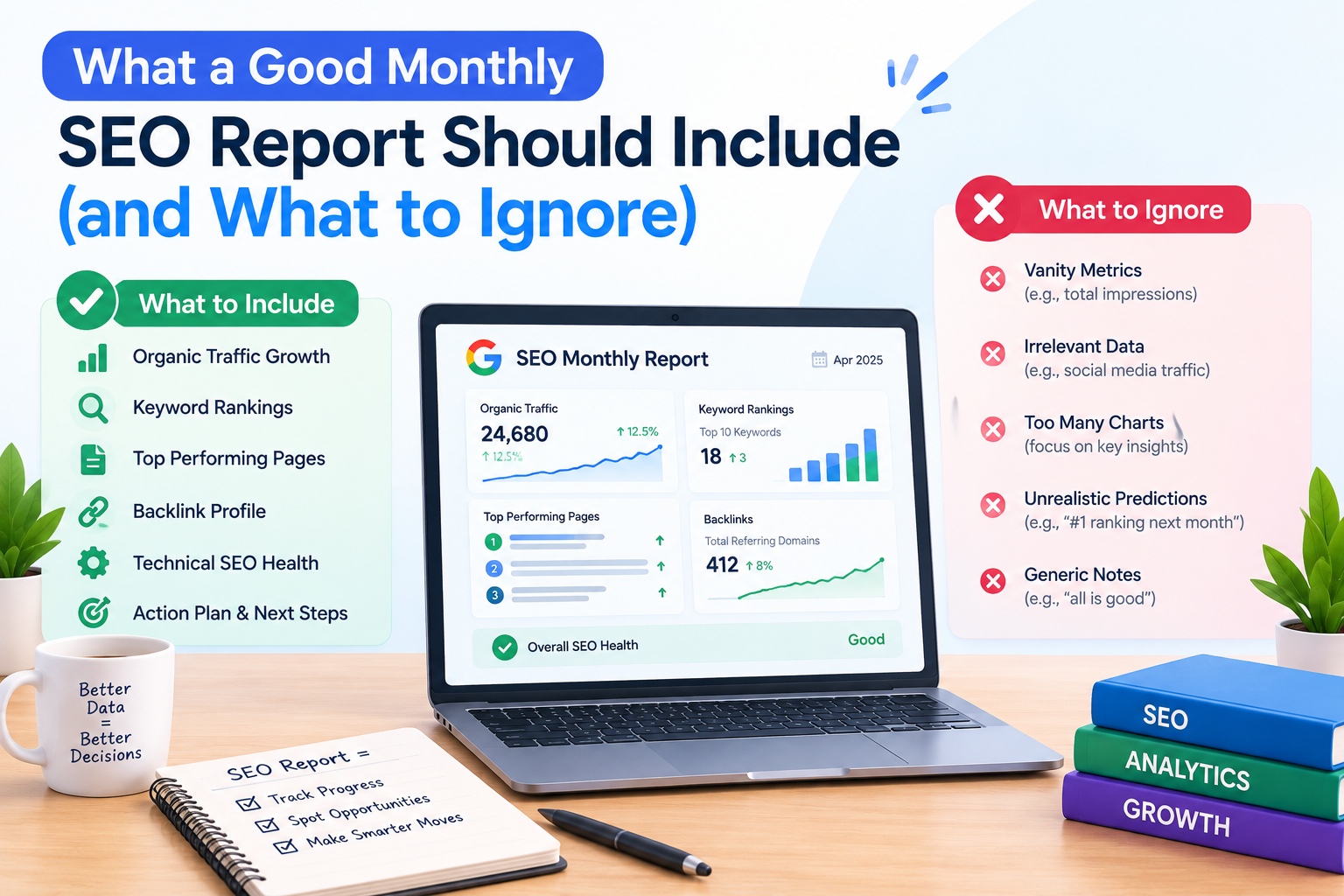
If you pay for SEO, the monthly report is how you find out whether your money is working. A good report tells you what was done, what changed and what happens next. A poor one is a stack of charts that makes activity look like progress.
Here is what to expect, and how to read it without being an SEO expert.
Key takeaways
- A good report says what was done, what changed, whether it led to enquiries, and what happens next.
- The leads and conversions section matters most; ask for it if it is missing.
- Treat impressions, total keyword counts, page views and authority scores as supporting signals, not proof of success.
- SEO builds over time, so early reports usually show work done and early movement before lead growth.
What a report is for
A monthly SEO report should answer four questions:
- What work was done this month?
- What changed in how people find the site?
- Did that lead to enquiries or sales?
- What will happen next month, and why?
If your report cannot answer these, ask for a better one.
The sections a good report includes
1. Summary in plain language
The first page should read like a short message from a person: a few lines on what happened, what went well, what did not and what is planned. If you have to decode jargon to understand the summary, the report is not written for you.
2. Work completed
A list of actual tasks, such as technical fixes, pages created or improved, content published, links earned and listings updated. This lets you check the agency is doing what the scope said.
3. Organic traffic
The number of visitors arriving from search engines, compared with the previous month and the same month last year if available. Seasonal businesses should compare year on year, because traffic naturally rises and falls through the year.
Traffic alone is not the goal, but a steady trend upward over several months is a good sign that SEO is working.
4. Keyword rankings
Where the site appears in Google for the terms you care about, and how that has moved. Look for:
- Rankings for terms that match what you sell, not just easy words
- Movement over several months, not day-to-day swings
- Local searches, if you serve a city or area
Rankings fluctuate. They are a signal, not a result.
5. Leads and conversions
This is the section that matters most. It shows how many enquiries, calls, form submissions or orders came from search traffic. If your report does not include it, ask why. Tracking needs to be set up properly for this, for example with Google Analytics 4 and conversion events on your forms and phone buttons.
6. Search Console highlights
Search Console shows how Google sees your site. A good report picks out:
- Which pages and queries bring impressions and clicks
- Pages with errors or that are not indexed
- Any manual actions or serious warnings
7. Technical health
Notes on site speed, mobile usability, broken pages and crawl problems, plus what has been fixed and what is still open.
8. Next month's plan
Specific actions for the coming month and the reason for each, tied back to what the data showed.
Numbers to treat carefully
Some measures look impressive but say little about business results on their own.
- Impressions. More people seeing your listing is good only if the right people are clicking and enquiring.
- Total "keywords ranking". A large number can include terms nobody searches for. Ask about the ones that matter.
- Page views. Easy to inflate and rarely tied to revenue.
- Domain authority scores. Third-party estimates, not something Google uses. Useful for rough comparison, not proof of success.
- Link counts. The quality of links matters far more than the quantity.
None of these are useless. They should support the story, not replace the leads section.
What to expect month by month
SEO builds over time. Technical fixes can show effects fairly soon, while competitive terms usually take several months. In the early months, expect reports to show work done and early movement in impressions and rankings. Lead growth usually follows later. A good agency explains this at the start so the first few reports do not come as a surprise.
Questions to ask about your report
- Can you show me which pages bring leads?
- How are leads tracked, and how do you know they came from SEO?
- Which of these numbers will you be judged on?
- What did you change this month, and what effect did it have?
- What is not working, and what will you do about it?
An agency that answers these openly is usually one worth keeping.
Checklist: is your report doing its job?
- It starts with a short, plain-language summary
- It lists the work actually completed
- It includes organic traffic with a clear comparison
- It shows rankings for terms that matter to your business
- It includes leads or conversions from search
- It flags technical problems and their status
- It ends with a specific plan for next month
How to read your report in ten minutes
You do not need to study every chart. Read the report in this order:
- The summary. Does it explain what happened in plain words?
- Leads from search. Are enquiries and conversions going up, flat or down?
- Organic traffic trend. Is it moving the right way over several months?
- Work completed. Does it match what was agreed?
- Next month's plan. Is it specific, and does it follow from the data?
If you can answer these five questions after ten minutes, the report is doing its job.
When to be concerned
Ask questions if you notice any of these:
- Reports that change format every month, which makes progress hard to compare
- Rankings reported only for brand terms or very easy phrases
- No lead or conversion data after several months
- A long list of tasks with no link to results
- Explanations that rely on jargon instead of plain language
- Sudden drops with no explanation or plan
A good agency treats these questions as normal. Dips happen in SEO, and what matters is that the agency can explain them and shows what it will do next.
How Ucodice reports
Our monthly reports cover traffic, leads and cost per lead, the work completed and the plan for the next month, using GA4 and Search Console data. If your current report leaves you guessing, ask for a free audit and we will show you what a clearer picture looks like.
You may also like our guides on best SEO tools in 2026 and local SEO for Noida and Delhi NCR.
Frequently asked questions
What should a monthly SEO report include?
A plain-language summary, work completed, organic traffic, rankings for terms that matter, leads from search, Search Console highlights, technical health and next month's plan.
Which SEO metrics matter most?
Leads or conversions from organic search, organic traffic trends and rankings for terms that match what you sell. Other numbers support these.
How do I know the leads come from SEO?
Tracking must be set up properly, for example with Google Analytics 4 and conversion events on forms and phone buttons. Ask your agency how leads are attributed.
How long before an SEO report shows leads?
It varies by site and competition. Technical fixes can help sooner, while lead growth from competitive terms usually follows over several months.