Software Making Company: The Complete Guide to Choosing the Right Partner in 2026

When you are looking for a software development company, it's not just about getting code. You want a solid partner who builds stuff that works well, grows with you, and supports your business goals.
But when you look at the search results, you mostly find:
- Directories and “top companies” lists
- Big brand homepages
- Marketplaces
- And generic service pages that all sound the same.
Very few pages explain:
- What a software making company actually does
- How to evaluate one properly
- What risks to watch out for
- and how to pick a partner who won't end up costing you more down the road.
This guide fills that gap.
This blog is made for founders, business owners, product managers, and decision-makers who want a smart, long-term pick—not just any name from a list.
What Is a Software Making Company?
A software development company designs, builds, tests, deploys, and maintains software solutions for other businesses.
That can include:
- Custom business software,
- Web and mobile applications,
- Enterprise systems,
- SaaS platforms,
- Internal tools and automation systems.
But here is the important part -
A good software company doesn't just "make software." It solves business problems with software.
The difference between a cheap vendor and a real partner is not in the tools they use—it’s in how they think about your problem.
Why Businesses Hire Software Making Companies
Most companies don’t build software in-house because:
- Hiring and managing a full tech team is expensive and slow,
- They need specialized skills for a limited time,
- They want faster time-to-market,
- They need experience they don’t already have,
- Or they’re building something outside their core expertise,
A strong software making company brings:
- Technical expertise,
- Delivery process,
- Project management,
- Quality control,
- And risk management.
Types of Software Making Companies (Important Distinction)
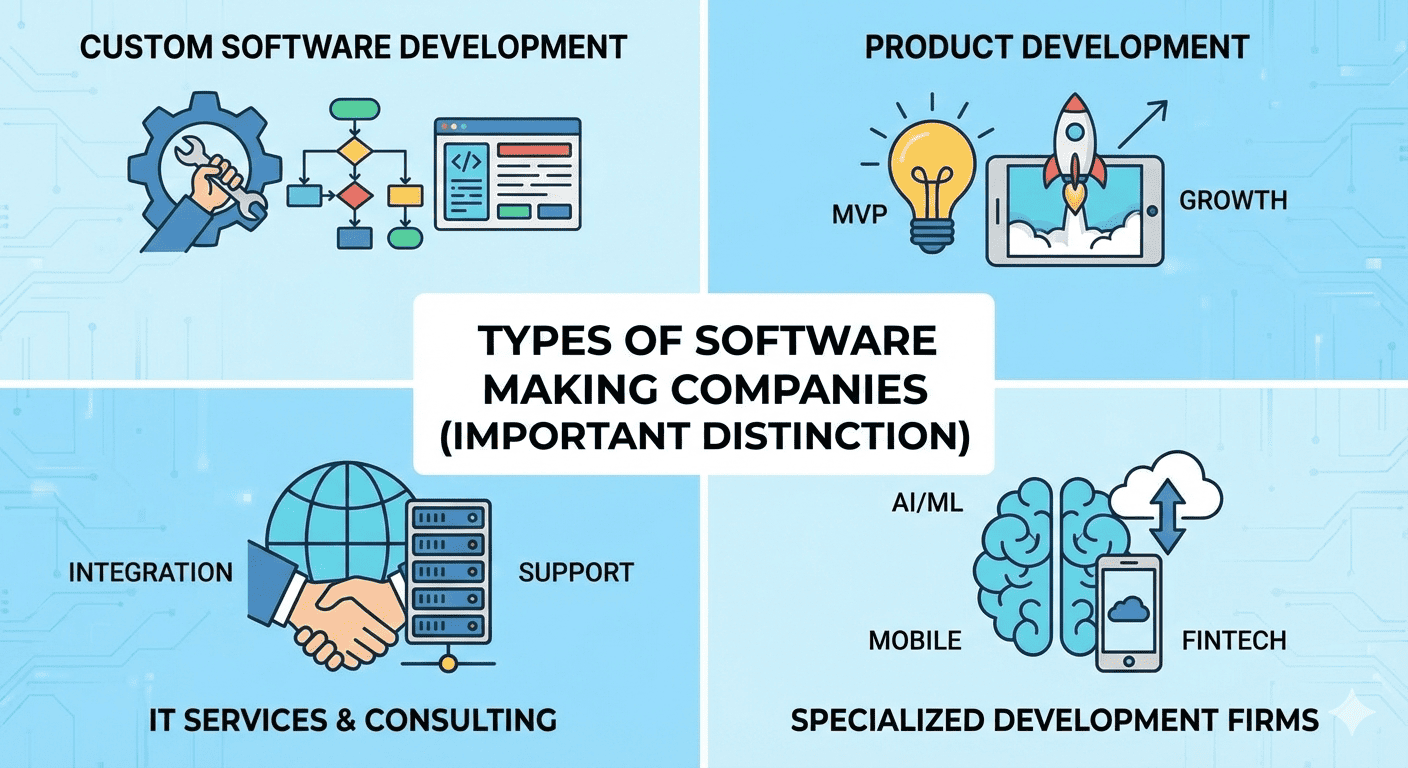
Not every software company does the same work. Knowing these types helps you find the right partner.
1) Custom Software Development Companies
These focus on:
- Tailor-made software for specific business needs,
- Enterprise systems,
- SaaS products,
- Quality control,
- Internal platforms and tools.
Best for: businesses with unique workflows or complex requirements.
2) Product Development Companies
These companies:
- Help you build a product from idea to launch,
- Handle MVPs, scaling, and iterations,
- Often work with startups and product teams.
Best for: founders building new digital products.
3) IT Services & Consulting Firms
These provide:
- Software development plus consulting,
- Modernization and migration,
- Integration and infrastructure services,
- Long-term support and operations.
Perfect for: companies doing digital upgrades or system changes.
4) Specialized Development Firms
These focus on niches like:
- Mobile apps,
- Cloud platforms,
- AI/ML systems,
- Fintech, healthtech, or ecommerce solutions.
Best for: projects needing deep domain expertise.
What Services Does a Software Making Company Usually Offer?
Most professional software making companies provide some combination of:
- Custom software development
- Web application development
- Mobile app development
- Cloud and backend development
- UI/UX design
- Quality assurance and testing
- System integration
- Maintenance and support
What really matters is how well they deliver these services, not just that they offer them.
The Software Development Lifecycle
A solid software company doesn't start coding right away. Here's what a typical process looks like:
1) Discovery & Requirements
- Understanding business goals
- Mapping user needs
- Defining scope and success metrics
- Identifying risks and constraints
Skipping this step is one of the most common reasons projects fail.
2) Architecture & Design
- choosing the right tech stack
- designing system architecture
- planning data flows and integrations
- creating UI/UX designs
Good architecture decisions save years of future pain.
3) Development
- Building features in iterations
- Regular reviews and demos
- Continuous testing
- Performance and security considerations
Most teams use agile or hybrid delivery models here.
4) Testing & Quality Assurance
- functional testing
- performance testing
- security testing
- user acceptance testing
Testing is not overhead—it’s risk insurance.
5) Deployment & Ongoing Support
- Production release
- Monitoring and bug fixes
- Feature improvements
- Scaling and optimization
How to Choose the Right Software Making Company
This is where most buyers make costly mistakes.
1) Evaluate Their Thinking, Not Just Their Portfolio
Pretty screenshots don’t guarantee good engineering.
Ask:
- How do you approach architecture decisions?
- How do you manage technical risk?
- How do you plan for scalability and maintenance?
- How do you handle changing requirements?
Good companies explain the trade-offs and choices, not just the tools they use.
2) Check Their Process Maturity
A reliable partner can clearly explain:
- how projects start,
- how planning is done,
- how progress is tracked,
- how quality is ensured,
- how releases are managed.
3) Communication Is a Deal-Breaker
Strong software making companies:
- Explain technical topics in simple terms,
- Give realistic timelines
- Communicate risks early,
- Keep you involved in decisions.
Poor communication causes more project failures than poor code
4) Don’t Choose Only Based on Price
Very low quotes often mean:
- planning is skipped,
- testing is reduced,
- scalability is ignored,
- maintenance becomes expensive later.
Consider the total cost over 3–5 years, not just the first bill.
Cost of Hiring a Software Making Company - Reality Check
There is no fixed price, because cost depends on:
When people talk about the “Big 4” in consulting, they usually mean:
- Project complexity,
- Technology stack,
- Team size and seniority,
- Timeline,
- Security and compliance needs,
- Long-term support requirements.
Common Mistakes Companies Make
Avoid these:
- starting development without clear requirements,
- choosing vendors only on price,
- ignoring scalability and security early,
- underestimating testing and QA,
- treating software as a one-time project
Most failed software projects fail because of bad decisions early, not because developers can’t code.
Software Making Company vs In-House Team
In-House Team
Pros:
- Full control
- Deep business knowledge
- Long-term continuity
Cons:
- Expensive to build and scale
- Slower to start
- Hard to cover all skill sets
Software Making Company
Pros:
- faster start
- access to diverse expertise
- proven delivery processes
- flexible scaling
Cons:
- requires good communication and governance
- you must choose the partner carefully
Lots of companies use a mix: they handle core strategy themselves and team up with a trusted partner for the work.
Final Takeaway
Picking a software development company is not just about buying services—it's a key business decision.
The right partner helps you:
- Reduce risk,
- Build faster,
- Scale safely,
- And turn software into a real business asset.
The wrong partner gives you:
- short-term progress,
- long-term technical debt,
- and expensive rewrites.
Take your time. Ask tough questions. This decision affects you for years.
FAQs: Software Making Company
What does a software making company do?
A software development company designs, builds, tests, deploys, and maintains software solutions for businesses. It helps them solve problems and reach goals using technology.
How do I choose the best software making company?
Focus on their process, technical decision-making, communication quality, scalability planning, and long-term support approach—not just portfolio or price.
Is it better to hire a software company or build in-house?
It depends on your goals, budget, and timeline. Many businesses use software companies to move faster and access specialized expertise while keeping strategy in-house.
How much does it cost to hire a software making company?
Costs vary widely based on project scope, complexity, team size, and support needs. The real metric is total cost of ownership over time, not just initial development cost.