In this article
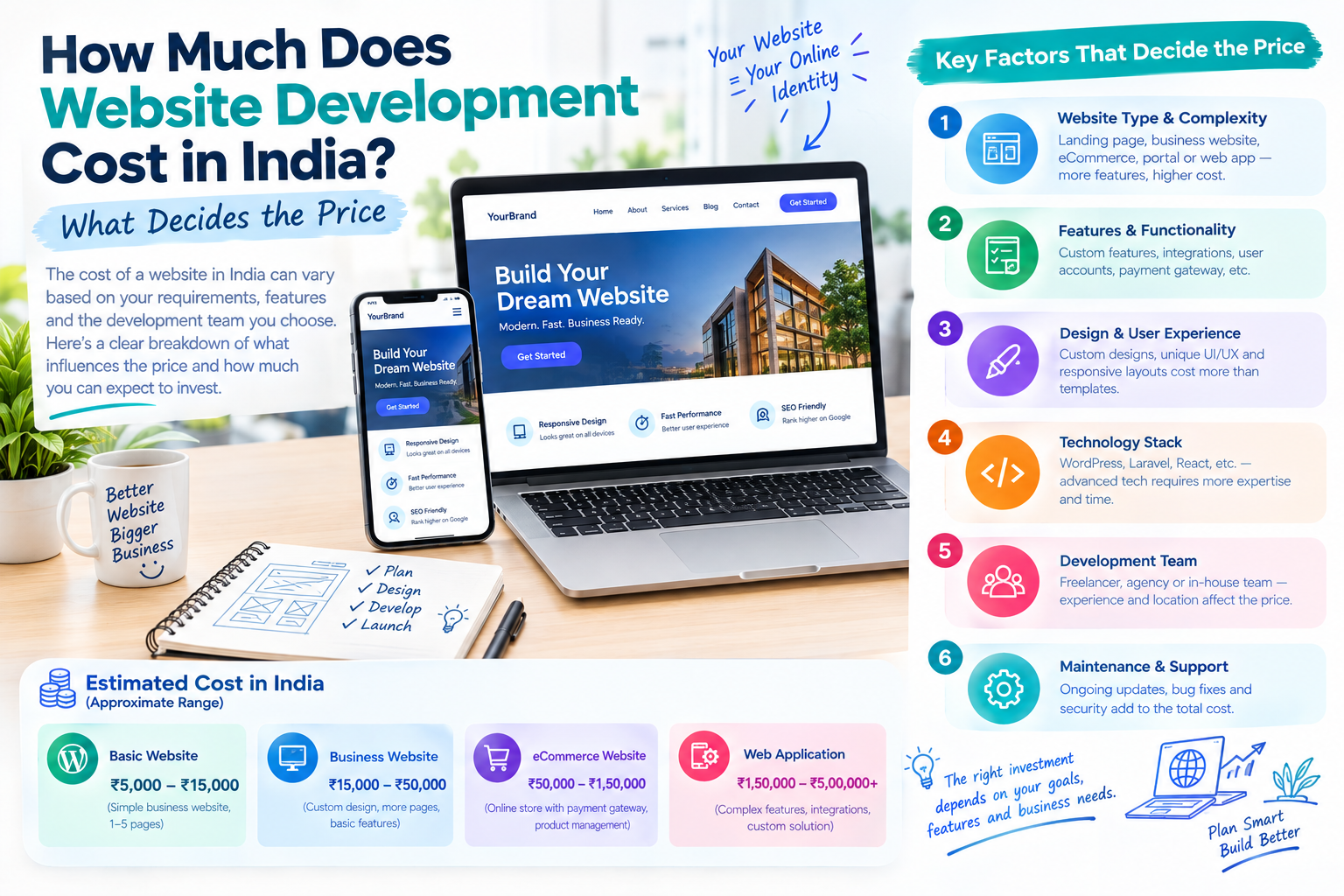
Ask five agencies what a website costs and you will get five different answers, and often none of them will be wrong. The price depends on what kind of website you need, how much of it is custom and what happens after launch. This guide explains each factor so you can describe your project clearly and compare quotes fairly.
Key takeaways
- The type of website matters most: a simple business site, a CMS site, an online store and a custom web application are different projects.
- Design, functionality, integrations and content decide the rest.
- Budget for running costs such as hosting, renewals and maintenance, not only the build.
- Compare quotes on what is included and excluded, not on the headline number.
The four kinds of website, and why the type sets the price
Before talking about money, decide which of these your project is closest to. The same word, "website", covers very different amounts of work.
| Type | Best for | What drives its cost |
|---|---|---|
| Business or brochure website | Introducing a company, its services and contact details | Number of pages, design quality, content and SEO set-up |
| CMS website | Sites your team will update often, such as blogs, news or large service sites | Content structure, templates, editing roles and any custom plugins |
| Online store | Selling products with carts, payments and shipping | Number of products, payment and delivery integrations, stock and order handling |
| Custom web application | Portals, dashboards, marketplaces and software products | Features, user roles, integrations, security and scale |
A business website is usually the smallest project. A custom web application is the largest, because it is closer to building software than to publishing pages. Many projects sit between two types, for example a business site with a booking system, and that is where a clear brief helps most.
What sets the price of a website
Once the type is clear, these factors move the cost up or down:
- Design: a template-based design is quicker than a fully custom design with original illustrations and animation.
- Number and kind of pages: ten simple pages are very different from a hundred pages with filters, search and templates.
- Functionality: contact forms are simple. Booking, user accounts, payments, dashboards and search take real engineering time.
- Integrations: each connection to a CRM, payment gateway, shipping provider or accounting tool adds work and testing.
- Content: if you need copywriting, photography or product data entry, it is a separate piece of work and cost.
- Performance and SEO: fast pages, clean structure and proper tracking take planning. They are cheaper to include at the start than to add later.
- Security: logins, payments and personal data need extra care and testing.
- Languages and devices: more languages and more complex layouts mean more design and testing time.
For a closer look at one common decision, see our guide on WordPress vs custom website development, which shows how the platform you choose changes both cost and flexibility.
What a website quote should and should not include
Two quotes with the same total can cover very different things. Check these items in each one:
- The list of pages and features, written down page by page.
- Number of design rounds and who approves each stage.
- Whether content writing, images and product uploads are included.
- Mobile design and testing on real devices.
- Basic SEO set-up: page titles, descriptions, structure, sitemap and analytics.
- Hosting, domain and SSL: included for a period, or for you to arrange?
- Third-party licences for themes, plugins or tools, and who pays for them.
- Training for your team and handover of files and logins.
- Support period after launch and what it covers.
If something you expect is missing from the quote, ask whether it is excluded or simply not mentioned. Surprises usually appear in the gap between those two answers.
The costs that continue after launch
A website is not a one-time purchase. Plan for these recurring items:
- Domain name renewal, usually yearly.
- Hosting, which varies with traffic and the size of the site.
- SSL certificate, sometimes included with hosting.
- Maintenance: software updates, security patches, backups and fixes.
- Content updates, new pages and improvements.
- Marketing: SEO, ads and email, which bring visitors to the site.
- Paid plugins, tools and services that renew each year.
A site that is never updated gradually becomes slower, less secure and less useful. Asking for a monthly maintenance option in the original quote is one of the simplest ways to avoid a large repair bill later.
Freelancer, agency or in-house team?
- Freelancer: often the lowest starting cost and good for small, well-defined sites. Check availability, backup when they are unwell or busy and who holds your logins.
- Agency or software company: a team with design, development, testing and project management under one roof. It suits larger or growing projects and gives continuity if one person leaves.
- In-house team: the best long-term control for a company whose website is central to its business, with the cost of salaries and management.
Whichever you choose, ask who owns the source code and accounts at the end. Our guide on choosing a website design and development company lists the questions to ask.
Ways to control the cost without cutting quality
- Launch in phases. Build the pages and features that matter most first and add the rest after you see how visitors behave.
- Prepare content early. Delayed text and images are a common cause of extra time and cost.
- Write a clear brief. Fewer revisions mean less rework.
- Use a CMS where it fits, so your team can make routine changes without paying for each one.
- Reuse proven components for standard features instead of building them from scratch.
- Be firm about the must-haves and honest about the nice-to-haves.
Avoid the opposite trap as well. The cheapest quote that leaves out testing, security and handover usually costs more later in repairs and lost customers.
How timelines connect to cost
Time and cost move together, because most of the price is people's time. Three things stretch a timeline more than any technical choice:
- Slow content: text, images and product data that arrive late.
- Slow feedback: waiting days to approve a design or answer a question.
- Changing scope: new pages and features added after work has started.
A clear brief, ready content and one person on your side who can approve quickly will shorten a project and lower its cost. Ask each company for a timeline with milestones, so you can see where your own input is needed.
Build a rough budget before you ask for quotes
You do not need exact figures to prepare. Write down your answers to these questions, and you will be able to discuss the budget sensibly with any company:
- Which type of website is this: business, CMS, store or web application?
- How many pages or product types will it have at launch?
- Which three features are essential, and which are nice to have?
- What content do I already have, and what must be created?
- What will I spend each month to run, maintain and promote it?
Treat the answers as a living document. After the first conversation with a company, update them, and keep a list of what each quote includes. Comparing two lists is far easier than comparing two totals.
Red flags in website quotes
- A fixed price given before anyone has asked about your goals or features.
- No written scope, or a scope that says only "as required".
- Unclear ownership of the code, design files, domain and hosting accounts.
- No mention of testing, security or mobile design.
- Pressure to pay the full amount upfront, with no stages or milestones.
- No answer when you ask to see live websites they have built.
Two projects, two very different scopes
Our own projects show how wide the range is. Stuffmybags.com is an online store built on Shopify, where the work centered on the storefront, search visibility and support for a startup. Lobital is a SaaS system for building management with dashboards, logs, signatures and key tracking, which is custom software delivered through the browser.
Both are "websites" in everyday language, but they involve different skills, different timelines and different budgets. Placing your project on that range is the first step to a realistic estimate.
How to get an accurate quote
Send each company the same short brief, so the quotes are comparable. It should say:
- What the website is for and who will use it.
- The pages and features you expect, even as a rough list.
- Examples of websites you like and why.
- Whether you have content, branding and a domain already.
- Any systems it must connect to.
- Your target launch date and the budget range you are comfortable with.
At Ucodice we hold a free consultation, then send a fixed quote and timeline in writing before work starts. You can read about our web development services or contact us with your brief. We do not publish fixed prices here, because a number without your requirements would mislead more than it helps.
Frequently asked questions
How much does a basic business website cost in India?
It depends on the number of pages, the design approach, whether content is included and what happens after launch. A small, template-based site is the lowest-cost kind of project, and a written quote based on your page list gives you a reliable figure.
Why do website quotes vary so much?
Because scope varies. Quotes can differ in design effort, number of pages, features, content, testing, SEO set-up and support. Compare what is included, not only the total.
Is a cheaper website worse?
Not always, but a very low price often means shortcuts in testing, security, mobile design or support. Ask what is included and look at live examples before deciding.
What are the ongoing costs of a website?
Domain renewal, hosting, SSL, maintenance and updates, plus any paid plugins or tools. Marketing to bring visitors is a separate budget.
Do I own the website after it is built?
You should. Agree in writing that you receive the source code, design files and the domain and hosting accounts, subject to the terms of any third-party tools used.